🏬
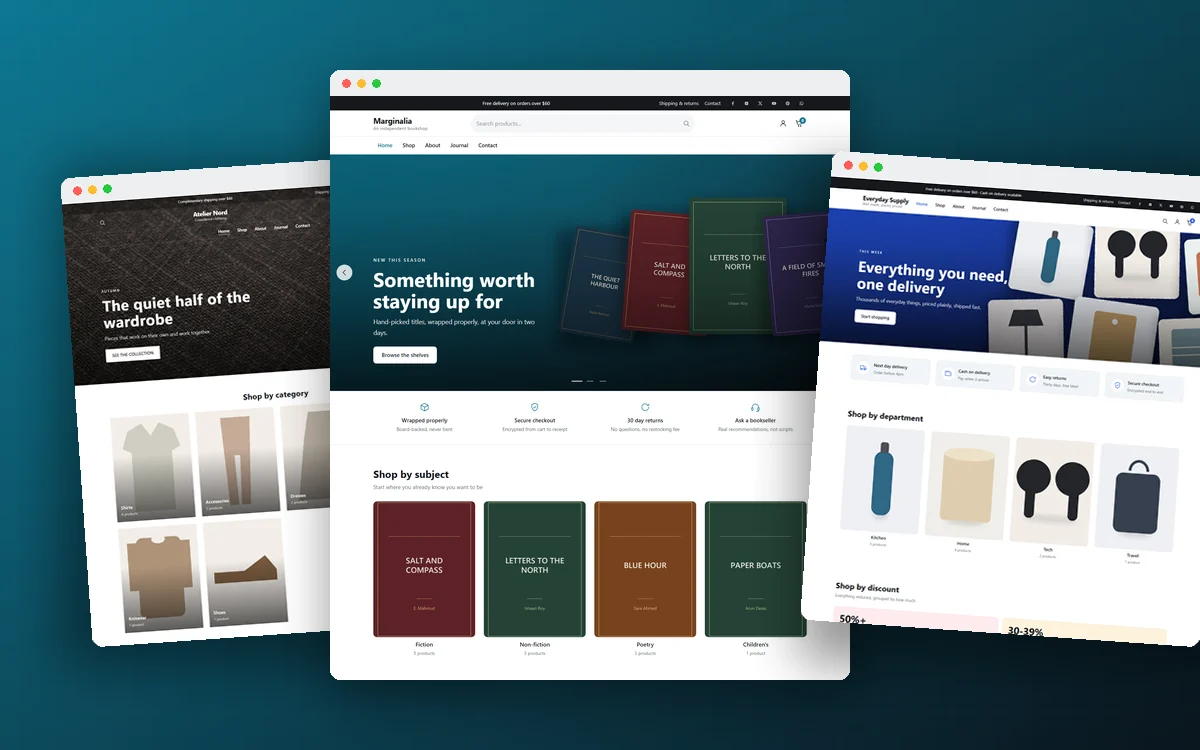
Three Complete Starter Sites
A book shop, a fashion boutique and a general store. Each imports a whole site in one click — colours, homepage layout, pages with real copy, menus, footer, blog posts and twelve products with images. Everything ships inside the plugin, so an import works with no internet access at all.
⚡
No jQuery, No Framework, No Builder
Every line of CSS is written for this theme. Nothing is inherited from Bootstrap or a page builder, so there is no unused stylesheet to download and no builder markup wrapped around your content.
🎛
A Real Control Panel
One Shopvane menu with the settings people actually change — brand colours, fonts, header layout, product card style, and the wording of every shop button. Each control writes the same setting the Customizer writes, so the two can never disagree.
🔍
Catalogue Filters That Work
Sort, discount tiers, in-stock only and categories with counts, on the shop page from day one. Every filter is a plain link, so a filtered view can be bookmarked, shared and indexed by Google — and none of it needs JavaScript.
🏷
Shop by Discount
Tiles for 50%+, 40–49%, 30–39% and so on. WooCommerce cannot filter on a discount because the discount is not stored anywhere — Shopvane works it out and keeps it, so the tiles are instant instead of loading the whole catalogue.
🧾
A Checkout Worth Finishing
Turn off company name, the second address line, state, postcode or order notes with a switch. Hiding a field also stops WooCommerce requiring it — so nobody is ever blocked by a field they cannot see.
📖
Sample Previews
Attach a sample PDF to a product and shoppers can read a few pages in a dialog before they buy. Built for book shops, useful for anything sold sight-unseen.
📱
App-Like on a Phone
A sticky bottom bar, a sticky buy button on product pages, a slide-in menu and a basket that opens without leaving the page. Two-column product grids where a phone can carry them.
🧱
Gutenberg and Elementor
Pages work with the built-in WordPress editor and with Elementor. Neither is required, and neither is treated as the second-class option — the block patterns and the Elementor widgets render through the same templates.